
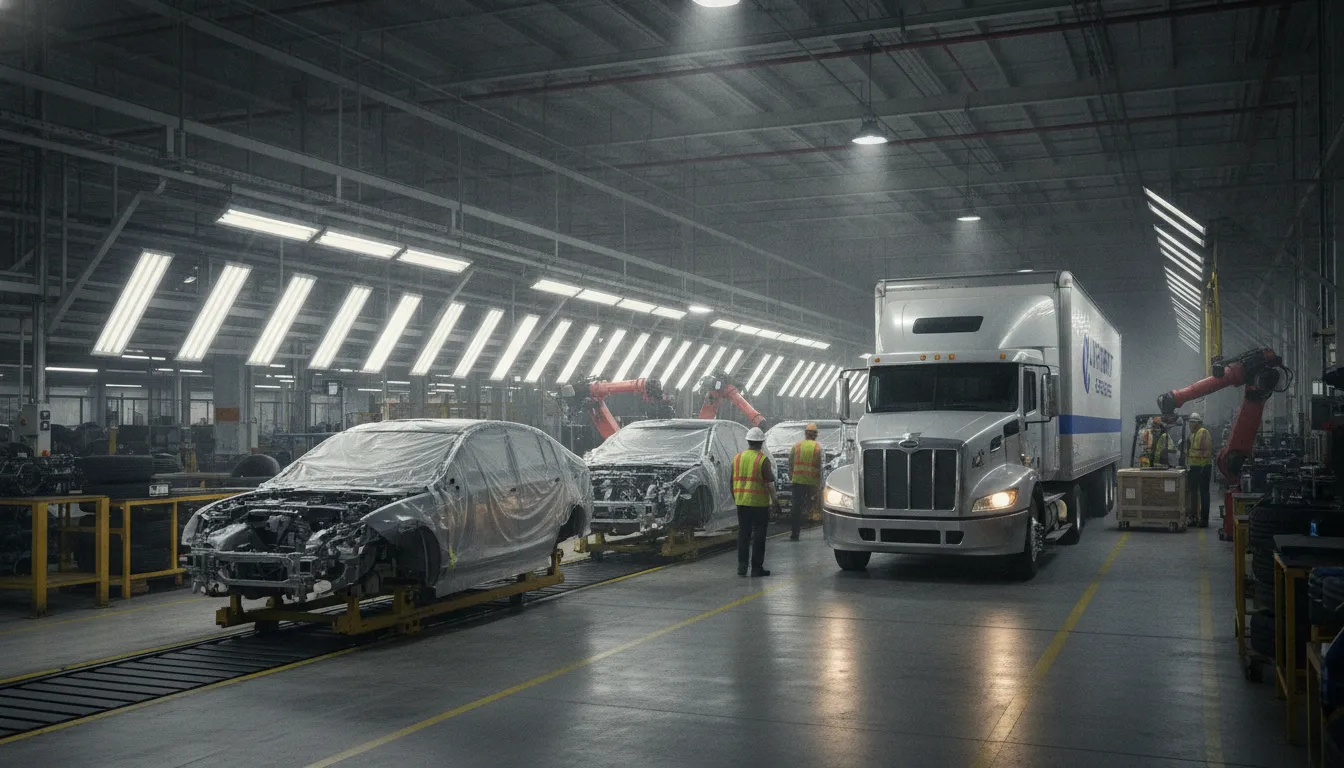
Cost of Production Downtime: Protect Your Bottom Line
Call Load One today to secure reliable transportation that prevents a total line shutdown. Every hour of production downtime can cost automotive plants over one million dollars.
The cost of production downtime currently averages about $9,000 per minute across all industries, according to a recent and very useful report by Pingdom. For large manufacturing plants and automotive teams, these financial losses can quickly climb to more than $1 million per hour when assembly lines stop. This total impact includes lost sales, idle labor, and the cost of restarting complex machines after a sudden stop. Using expedited freight services allows your team to move critical parts to your site in hours instead of waiting for days. This proactive strategy protects your production schedule; by investing in private transport, you can avoid huge costs and keep your factory floor running smoothly 24/7.
Every manager knows that unplanned stops hurt, but few can name the exact total bill for a shut line. Our guide on What Is the True Cost of Production Downtime? covers the hard data every logistics leader needs, and the clear path begins with
What Is the True Cost of Production Downtime?
Production downtime is more than a minor delay. It is a major risk that can cost firms millions in a short time. For most shops, the expedited freight solutions is measured in thousands of dollars per minute. Knowing these costs helps you plan a better supply chain.
Average Hourly and Minute Costs
The price of a stopped line has grown lately. Recent data shows the average cost across all sectors is about $9,000 per minute. This means a single hour of lost work can cost $540,000. You can find more data on these trends from Pingdom.
In a recent study by ABB, 83% of leaders said unplanned downtime costs them at least $10,000 per hour. Many firms face much higher rates. About 76% of those polled estimate their costs can reach $500,000 per hour. For about 7% of firms, the cost goes even higher.
Industry Impacts and High Stakes
Costs vary by field, but the stakes are highest in manufacturing. Equipment failure causes 80% of all unplanned downtime in these shops. This fact comes from the TWI Institute. In the automotive world, the price of a stop is even steeper. A stopped line at an auto OEM can cost over $1 million per hour.
These high costs make fast response times vital. Using reliable expedited freight solutions is one of the best ways to keep a plant running. Getting a critical part delivered in hours instead of days can save a firm hundreds of thousands of dollars.
How to Calculate Your Downtime Cost
To find the true cost of production downtime for your plant, you must look at a few factors. Use a simple formula to get a clear picture. The total cost is the sum of lost revenue, idle labor costs, and recovery fees.
Formula: Cost of Downtime = (Lost Revenue per Hour) + (Cost of Idle Labor) + (Recovery and Penalty Costs). For example, a plant that makes 60 cars per hour at $10,000 profit each loses $600,000 in revenue alone. When you add the cost of workers and machine restart fees, the total price rises fast.
Why Should Manufacturers Treat Expedited Freight as Insurance?
Most manufacturers view shipping as a cost of doing business. But for those in just-in-time industries, expedited freight is a form of risk management. It acts like an insurance policy against the high price of a line shutdown. When a parts shortage stops your line, the financial loss grows by the minute.
The ROI of Expedited Shipping
The math for emergency freight is simple. A typical expedited shipment may cost about $2,000 to move a critical part across the country. Compare this to the cost of production downtime, which can reach $500,000 per hour for many manufacturers. Paying for speed is a small price to protect your revenue and your client ties.
Choosing to use emergency shipping is about ROI, not just speed. One hour of uptime saved by a fast delivery can pay for the shipping cost many times over. This makes it one of the most effective tools for production downtime prevention. It changes a big crisis into a small delay that your team can manage.
| Factor | Standard Shipping | Expedited Freight |
|---|---|---|
| Direct Cost | Low cost per mile | Higher premium rate |
| Response Time | 24 to 48 hours | 90 minute pickup |
| Line Status | High risk of stop | Keeps production live |
| Financial Impact | Up to $500K/hr loss | Small fraction of loss |
| Availability | Business hours only | 24/7/365 support |
Asset-Based Reliability
To treat freight as insurance, you need a partner that owns the trucks. Many brokers just search for trucks, which adds time when you have none. Load One uses an asset-based fleet to give you more control. This allows for a 90-minute response time for most emergency shipments.
Working with a carrier that has its own equipment means less risk for your supply chain. You get real-time tracking and direct contact with the people moving your freight. You can learn more about Load One and how our 400 years of combined experience helps manufacturers stay on schedule.
How Does Expedited Shipping Prevent Production Downtime?
Unplanned downtime is a major threat to any plant. When a machine breaks or a part goes missing, the whole line can stop. This costs money every second. Research from the National Institute of Standards and Technology shows that downtime costs U.S. plants over $100 billion each year. Using fast freight helps you avoid these big losses. It acts as a safety net for your supply chain. A high expedited freight solutions comes from keeping your team at work and your orders moving.
Quick Help for Urgent Needs
Speed is the main factor when a line stops. You cannot wait days for a new part to arrive. Most freight plans are too slow for a crisis. You need a partner that can move as soon as you call. This is where expedited freight solutions give you the best value. We focus on getting your parts on the road in minutes, not days. This fast action keeps your team at work and your goals on track. It prevents small gaps from becoming major plant shutdowns.
A Direct Path to Success
Standard shipping often has many stops. Your freight might sit in a hub for a long time. Expedited freight is not the same. It uses one truck just for your load. This means the truck goes straight from the pickup point to your plant. There are no other stops or delays along the way. For the most urgent needs, air freight and charter services can cut travel time even more. This direct path offers clear value by moving goods as fast as we can.
The Five Steps to Stop Downtime
Load One uses a clear plan to stop downtime before it starts. We follow these steps to make sure your cargo arrives on time.
- Ask for a quote through our 24/7 team or online portal. We give you fast pricing so you can make a quick choice.
- We send a driver for a same-day pickup. Our usual time to reach your door is just 90 minutes.
- The driver takes a direct route to your plant in one truck. This removes the risk of hub delays or missed turns.
- You track your load in real time with our GPS systems. We give you quick updates at every stage.
- The driver drops off the parts and gets a signed receipt. Your team can start the line with no more delay.
How Do You Calculate the ROI of Expedited Shipping?
Calculating the return on investment (ROI) for expedited shipping starts with the cost of doing nothing. For many plants, a single part shortage can halt a whole line. You can find the ROI by looking at the cost of the downtime you avoid versus the cost of the fast freight. Use this formula to see the value: (Cost of downtime avoided – Cost of expedited shipping) / Cost of expedited shipping = ROI.
The Impact of Production Downtime
Downtime is a major risk for lean plants that use just-in-time supply chains. When a line stops, the costs add up fast. Research from ABB shows that 83% of leaders say unplanned stops cost at least $10,000 per hour. For 76% of those leaders, the cost can reach $500,000 per hour. If you pay $2,000 for a van to bring a part, and it saves you from one hour of a $500,000 stop, your ROI is 24,900%.
Why Manufacturers Invest in Fast Freight
Expedited shipping acts as a form of insurance for your supply chain. Despite the high risks, about 33% of businesses have not updated their gear in the last two years. This lack of change often leads to more frequent stops. Our supply chain management solutions help you manage these risks. By using fast shipping, you protect your bottom line from the high price of idle labor and lost sales. For more data on these costs, you can view reports from the NIST.
Which Industries Need Expedited Freight Most to Protect Production?
Every minute of unplanned downtime costs money, but some sectors face higher stakes than others. When an assembly line stops, the cost of production downtime can reach $10,000 to $1 million per hour. For these industries, emergency logistics is a vital tool to keep operations running.
Automotive and JIT Manufacturing
The car industry uses just-in-time (JIT) methods to keep parts moving. A single missing bolt can stop a whole assembly line. For many car makers, one hour of stopped work costs more than $1 million. Using air freight and charter services helps these plants get parts in hours. This speed prevents deep losses and keeps work on schedule.
Heavy Equipment and Machinery
Heavy equipment firms often deal with field service emergencies. When a big machine breaks on a job site, it can stall a whole project. These firms need specialized transport for oversized equipment to move parts fast. This keeps projects on track and prevents costly delays for their clients.
General Manufacturing and Healthcare
Many plants need raw materials to start their day. A gap in the supply chain can lead to idle labor and lost sales. In healthcare, getting critical supplies is even more vital. Hospitals and labs rely on fast shipping to get life-saving tools and drugs. Data from ABB Research shows that 83% of leaders say downtime costs at least $10,000 per hour. Expedited freight is the best way to stop these costs before they grow.
2:
What Should You Look for in an Expedited Freight Partner?
3: 4:
Not every shipping provider can handle a production emergency. Choosing the right expedited freight partner is as important as having the plan itself. Here are the criteria manufacturers should use when evaluating a partner.
5: 6:
Asset-Based Fleet vs Broker Model
7: 8:
A broker finds a truck from a third party, which adds time and uncertainty. An asset-based carrier owns its fleet and can dispatch immediately. Load One operates an asset-based model with company-owned sprinter vans, straight trucks, and tractor-trailers, supplemented by 70+ partner carriers for peak capacity. This hybrid model ensures availability even during high-demand periods. Learn more about Load One.
9: 10:
Twenty-Four-Seven Availability
11: 12:
Production emergencies do not happen during business hours. A reliable expedite partner offers 24/7/365 dispatch and support. When a weekend breakdown threatens Monday production, you need a carrier that answers the phone at 2 AM on a Sunday. Load One’s dispatch operates around the clock.
13: 14:
Industry Experience and Technology
15: 16:
The best partners understand your industry. For automotive manufacturers, this means familiarity with JIT delivery windows, EDI integration, and IATF 16949 quality standards. Real-time GPS tracking, AI-powered route optimization, and automated proof of delivery are baseline expectations, not extras. Load One, the 2019 CCJ Innovator of the Year, brings over 400 years of combined transportation management experience and comprehensive supply chain management solutions.
2:
Frequently Asked Questions About Production Downtime and Expedited Freight
3: 4:
What is the average cost of production downtime per hour?
6:
The average cost of downtime across all industries is approximately $9,000 per minute, or $540,000 per hour. For automotive manufacturers, downtime can exceed $1 million per hour due to the complexity of just-in-time supply chains and the value of stopped production lines.
9:
10:
11:
12: 13:
How does expedited shipping help prevent production downtime?
15:
Expedited shipping provides guaranteed, dedicated transport for critical parts within hours, not days. With same-day pickup within 90 minutes and 24/7/365 availability, expedited carriers can respond immediately to supply chain disruptions before they cause a production line stop. This rapid response capability is essential for just-in-time manufacturing environments.
18:
19:
20:
21: 22:
What causes unplanned production downtime?
24:
Equipment failure accounts for 80% of all unplanned downtime in manufacturing. Other causes include supply shortages, inventory gaps, labor shortages, human error, power outages, extreme weather, poor maintenance, and logistics disruptions. Many of these root causes can be mitigated with a proactive expedited freight strategy.
27:
28:
29:
30: 31:
Is expedited shipping worth the cost for manufacturers?
33:
Yes. While expedited shipping carries a premium over standard freight, it is far cheaper than a production line shutdown. When a single hour of downtime can cost $100,000 to $1 million, paying a few thousand dollars for emergency expedited delivery delivers exceptional ROI. Many manufacturers save hundreds of thousands of dollars per incident by using expedited freight to prevent a stop.
36:
37:
38:
39: 40:
How do you calculate the cost of production downtime?
42:
The standard formula is: Cost of Downtime = Lost Revenue per Hour + Cost of Idle Labor + Recovery Costs + Penalty or Failure Costs. For example, an automotive plant producing 60 vehicles per hour at $10,000 profit per vehicle loses $600,000 in revenue per hour before factoring in labor and recovery expenses.
45:
46:
47:
2:
Ready to Protect Your Production Line from Costly Downtime?
3: 4:
Production downtime is expensive, unpredictable, and preventable. The right expedited freight partner gives you the ability to respond to supply chain disruptions in minutes, not days. Load One’s asset-based fleet, 90-minute average response time, and 24/7/365 dispatch mean your production line stays running.
5: 6:
Do not wait for a crisis to find out if your freight partner can deliver. Contact Load One to set up an expedited shipping plan tailored to your production needs. When every minute of uptime matters, have a partner ready to deliver.