
Cross-Border Logistics Automotive: US-Mexico Trade Regulations Guide
Get a clear understanding of US-Mexico cross-border logistics automotive regulations before your next shipment clears customs. A $138.2 billion US auto parts deficit with Mexico is reshaping how automotive manufacturers approach cross-border logistics. For supply chain leaders at automotive OEMs and tier-one suppliers, the stakes are high: strict USMCA Rules of Origin requiring Regional Value Content above 75 percent. New 25 percent Section 232 tariffs on vehicles and parts, and 18,000 trucks crossing the Laredo World Trade Bridge every day.
Contact Load One to discuss your cross-border shipping requirements.
Cross-border logistics automotive solutions from an experienced asset-based carrier help manufacturers navigate USMCA compliance, tariff mitigation, and customs pre-clearance. Load One combines C-TPAT and NEEC certifications, a 15,000 square foot Laredo facility. And over 400 years of combined transportation management experience to keep time-critical automotive freight moving across the US-Mexico border without costly delays. Request a quote to discuss your cross-border shipping requirements.
This guide covers the four areas every automotive logistics leader must understand: USMCA compliance thresholds. Customs pre-clearance strategies, Section 232 tariff mitigation, and how the right carrier partner simplifies cross-border freight operations.
What Are the Key USMCA Compliance Requirements for Automotive Shippers?
The USMCA imposes strict Rules of Origin for duty-free automotive trade across North America. Shippers must meet Regional Value Content thresholds above 75 percent for passenger vehicles. Satisfy Labor Value Content mandates requiring manufacturing labor at 16 dollars per hour or higher, and comply with steel and aluminum sourcing rules. Alternative Staging Regimes expired in 2025, making full compliance mandatory for all automotive shipments.
The US-Mexico-Canada Agreement sets the compliance framework for all duty-free automotive trade across cross-border logistics operations across North America. Supply chain leaders must track every component’s origin to prove their goods qualify for preferential tariff treatment. According to the 2026 USTR USMCA Autos Report to Congress, over 90 percent of vehicles produced in Mexico are for export, with 79.7 percent heading to US markets. This makes USMCA compliance a daily operational requirement, not a periodic exercise.
Regional Value Content Thresholds
The RVC test measures the percentage of a vehicle or part’s value originating from North America. Passenger vehicles must meet a 75 percent RVC threshold, while core parts require 75 percent and other parts 65 percent. Shippers must document origin for every component, from engines to electrical wiring harnesses. The table below summarizes the key compliance elements every automotive shipper must track.
| Requirement | What It Measures | Why It Matters for Shippers | Status (2026) |
|---|---|---|---|
| Regional Value Content (RVC) | Percentage of vehicle value from North America | Must track part origins across the entire supply chain to prove thresholds | Full enforcement (ASRs expired 2025) |
| Labor Value Content (LVC) | Share of vehicle made by workers earning $16+/hour | Wage data must accompany customs filings; affects sourcing decisions | Full enforcement |
| Section 232 Tariffs | 25% on autos/parts and medium/heavy trucks | Direct cost impact on every non-compliant crossing | Active since Apr/Nov 2025 |
| Import Adjustment Offset | 3.75% of MSRP credit for US-assembled autos | Reduces tariff burden for parts used in US assembly | Available through Apr 2030 |
| 2026 Joint Review | Tri-lateral assessment of ROO effectiveness | Could raise RVC floors or change LVC tracking | Ongoing |
Labor Value Content Standards
LVC rules require that a defined portion of a vehicle’s manufacturing labor occurs at wages of 16 dollars per hour or higher. This provision aims to raise production standards across the trade bloc. Shippers must now include wage data alongside traditional customs documentation. Non-compliance with LVC thresholds can result in losing duty-free status, adding the full 25 percent Section 232 tariff to impacted shipments.
The 2026 USMCA Joint Review, currently underway, may raise RVC floors or modify LVC tracking requirements. Supply chain teams should prepare for potential rule tightening and work with logistics partners who monitor these regulatory shifts.
How Does Customs Pre-Clearance Speed Up Automotive Freight?
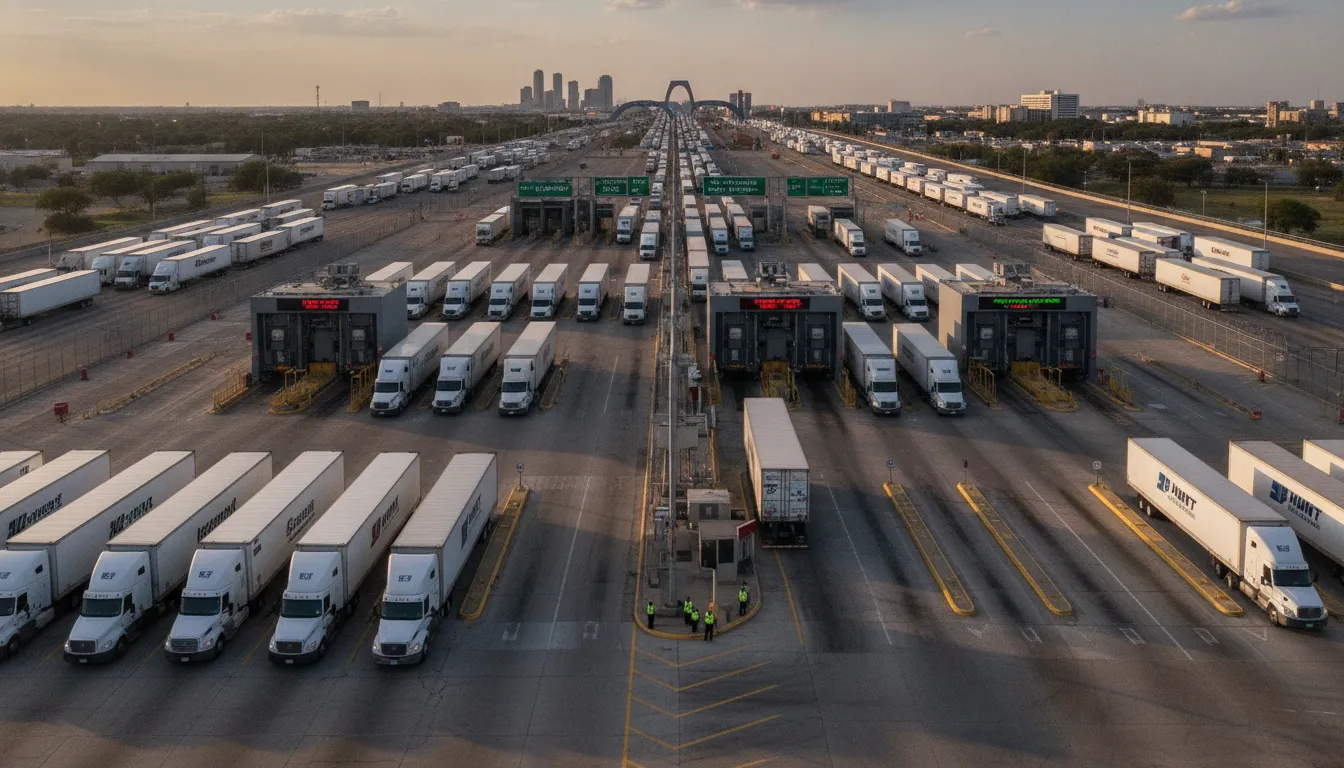
Customs pre-clearance programs like ACE e-Manifests, PAPS, and PARS allow automotive shippers to file documentation before trucks reach the border, reducing inspection times and preventing assembly line stoppages. The Laredo World Trade Bridge processes 18,000 trucks daily, handling 40 percent of all US-Mexico trade. Carriers with C-TPAT and NEEC certification access expedited lanes that bypass random inspections.
For just-in-time automotive manufacturing, even a one-hour border delay can halt production. Automotive freight differs from general cargo because parts must arrive in precise sequence and quantity. Pre-clearance programs give logistics teams control over border timing. Top shippers follow a structured process to minimize delays.
- Submit the e-Manifest before arrival. Carriers use the Automated Commercial Environment (ACE) to file cargo data before the truck reaches the port. Giving CBP agents time to review documentation while the truck is still in transit.
- Coordinate dual customs brokers. Most cross-border loads require a US broker and a Mexico broker working from aligned bills of lading to prevent data gaps that trigger secondary inspections.
- Select the correct pre-entry system. PAPS for US-bound loads and PARS for Canada-bound shipments link the carrier manifest to the broker entry, enabling automated clearance at the crossing.
- Use in-bond authority for transiting goods. Automotive parts passing through the US to a third country can move under in-bond status without formal entry, avoiding duty payments and inspection delays.
- Leverage trusted trader programs. Load One’s C-TPAT and NEEC certifications signal low-risk status to CBP, resulting in fewer random inspections and faster lane access for time-critical parts.
Certified carriers provide additional layers of verification. Load One operates a 15,000 square foot Laredo cross-border facility with cross-dock capabilities and bilingual customs support, enabling pre-clearance checks before trucks reach the bridge. This reduces the risk of documentation errors that cause secondary inspections and production delays.
Talk to Load One’s cross-border logistics team to learn how pre-clearance programs can protect your production schedule.
How Can Automotive Manufacturers Mitigate Section 232 Tariff Costs?
Section 232 tariffs add 25 percent to automotive and parts imports, with the same rate applied to medium and heavy trucks since November 2025. Mitigation strategies include claiming the import adjustment offset (3.75 percent of MSRP for US-assembled vehicles), auditing HS codes to ensure correct duty rates. Consolidating shipments to reduce formal entry counts, and using in-bond transport for goods not entering US commerce.
These tariff actions contributed to a $6.6 billion decline in the US automotive parts deficit with Mexico from 2024 to 2025. According to the USTR 2026 USMCA Autos Report. However, the cost burden remains significant for manufacturers who have not restructured their supply chains. Several mitigation approaches can reduce the financial impact.
- Apply the import adjustment offset. Vehicles assembled in the US qualify for a credit of 3.75 percent of MSRP against Section 232 tariffs. This offset, available through April 2030, can save millions for high-volume production lines.
- Audit HS classification codes. Incorrect HS codes often result in overpayment. Periodic audits ensure each part uses the lowest legal duty rate.
- Consolidate less-than-truckload shipments. Combining multiple small shipments into full truckloads reduces the number of formal customs entries and associated processing fees.
- Use in-bond transport where applicable. Automotive components passing through the US for final assembly in Canada can move in-bond, deferring duty payments and inspections.
These strategies require precise documentation and real-time visibility into cross-border shipment status. Load One’s in-house customs brokerage team provides direct oversight of classification, entry filing, and compliance documentation, reducing the risk of errors that trigger penalties.
Why Choose Load One for Cross-Border Logistics Automotive Shipping?
Load One provides asset-based cross-border logistics with C-TPAT, NEEC, and CSA certifications, a dedicated 15,000 square foot Laredo facility, and over 400 years of combined transportation management experience. Our bilingual operations team manages ACE filings, coordinates dual customs brokers, and monitors every shipment 24/7/365 to keep automotive production lines running.
Automotive manufacturers require logistics partners who understand the regulatory complexity of cross-border trade. Load One offers direct control over the full shipping process, from customs documentation to final delivery. Our Laredo hub sits minutes from the World Trade Bridge, enabling pre-clearance verification before trucks reach the gate. This proximity reduces border wait times and ensures just-in-time automotive logistics arrive on schedule.
Real-time shipment visibility is critical for production planning. Load One’s technology platform provides tracking data that integrates with your supply chain management systems. Giving logistics leaders the information they need to make informed decisions about inventory flow and production scheduling.
Our cross-border services include ground expedite, air freight and charter, specialized transport, and supply chain management, all backed by 24/7/365 availability. Every shipment receives attention from bilingual specialists who understand both US and Mexican customs procedures.
Frequently Asked Questions About Cross-Border Logistics Automotive
Automotive manufacturers commonly ask about USMCA compliance documentation, tariff costs, customs clearance timelines, and carrier certification requirements. Below are answers to the most frequent questions from supply chain and logistics leaders managing cross-border automotive freight.
What documentation is required for USMCA compliance?
Shippers must maintain a valid USMCA Certificate of Origin, supporting documentation proving Regional Value Content calculations, labor value content wage data, and bills of lading for each shipment. Load One’s customs brokerage team can help prepare and verify these documents before shipments reach the border.
How long does customs clearance take at the Laredo port?
With proper pre-clearance documentation, freight can clear in 30 to 60 minutes. Without pre-filed e-Manifests or with documentation errors, clearance can extend to several hours. Working with a C-TPAT-certified carrier like Load One significantly reduces inspection rates and clearance times.
What is the difference between PAPS and PARS pre-clearance?
PAPS (Pre-Arrival Processing System) is used for shipments entering the United States from Mexico. PARS (Pre-Arrival Review System) is used for shipments entering Canada. Both systems link the carrier’s manifest to the customs broker’s entry filing, enabling automated clearance at the port of entry.
How does C-TPAT certification benefit automotive freight?
C-TPAT (Customs-Trade Partnership Against Terrorism) certification signals low-risk status to CBP, resulting in fewer random inspections, expedited processing at ports of entry, and access to dedicated FAST lanes. For time-critical automotive parts, this means reliable transit times and fewer production stoppages.
Can Load One handle customs brokerage in-house?
Yes. Load One’s in-house customs brokerage team manages ACE filing, dual-broker coordination, HS code classification, and compliance documentation for cross-border automotive shipments. This direct oversight reduces documentation errors and provides a single point of accountability for customs clearance.
Ready to Simplify Your Cross-Border Logistics Automotive Shipping?
Load One delivers US-Mexico cross-border solutions that keep automotive production lines running. Our asset-based fleet, certified Laredo facility, and in-house customs expertise reduce border delays and tariff risk. Contact our team today to discuss your cross-border logistics requirements and request a customized quote tailored to your supply chain needs.
Request a Quote or reach out to speak with a cross-border logistics specialist.